Product packaging is no longer just about appearance. For many Philippine businesses, packaging also needs to protect the product, guide customers, support traceability, and help prove authenticity.
This is why QR code label printing has become increasingly important for brands seeking to connect their physical products with digital verification, customer engagement, and supply chain visibility.
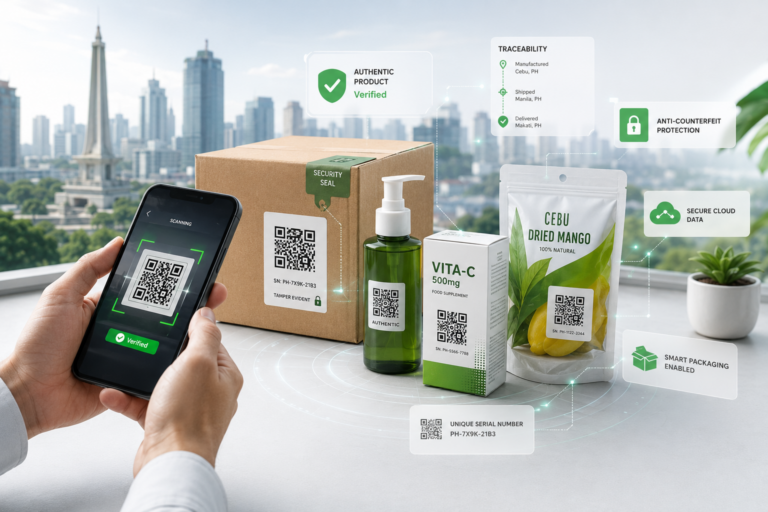
A well-designed QR code label can do more than send a customer to a website. It can help customers verify a product’s authenticity, register a warranty, access product information, join a promotion, submit feedback, or check whether the packaging has been tampered with.
For brands dealing with counterfeits, product diversion, fake online listings, or customer trust issues, QR labels can be part of a wider product security strategy. When combined with tamper-evident labels, hologram stickers, smart packaging systems, and security seals, they can give businesses a stronger way to protect their products from the factory to the customer.
At Packtica Philippines, QR code label printing can support product authentication, anti-counterfeit protection, customer engagement, and smarter packaging for different industries in the Philippines.
What Is A QR Code Label?
A QR code label is a printed label with a scannable QR code. Once scanned, the QR code can lead users to a digital page, verification system, product information, warranty form, feedback page, or promotional campaign.
For simple use cases, a QR code may only link to a website. But for businesses that need stronger product security, a QR code label can include more advanced features, such as:
- Unique serial numbers
- Dynamic QR code links
- Product authentication pages
- Scan tracking
- Batch or item-level traceability
- Customer feedback forms
- Warranty registration
- Hologram sticker integration
- Tamper-evident materials
This makes QR labels useful for brands that want packaging to do more than carry product details. With the right setup, the label becomes a bridge between the physical product and the brand’s digital system.
Why QR Code Label Printing Matters For Philippine Businesses
Many Philippine brands sell through a mix of distributors, retailers, e-commerce platforms, resellers, and direct customers. This creates more opportunities for products to be copied, diverted, tampered with, or misrepresented.
QR code label printing helps address these issues by giving each product a clear digital touchpoint.
For example:
- A cosmetics brand can use a QR code label to let customers check product authenticity.
- A food and beverage company can use QR labels to provide batch details, product information, or recall notices.
- An electronics brand can use QR labels for warranty registration and product verification.
- An FMCG brand can use QR labels for promotions, loyalty campaigns, or customer feedback.
- A logistics company can combine QR labels with a security seal sticker to help detect shipment interference.
The value is not just in the printed QR code. The value comes from what happens after the scan.
How QR Labels Fit Into Smart Packaging In The Philippines
Smart packaging in the Philippines refers to packaging that connects physical products with digital experiences, data, or verification systems.
QR labels are among the most practical ways to implement smart packaging, as customers already know how to scan them with their phones. This makes QR labels easy to use across many industries.
- Smart packaging can help brands:
- Share product information
- Confirm product authenticity
- Track scan activity
- Support customer service
- Collect feedback
- Run promotions
- Register warranties
- Improve traceability
- Strengthen anti-counterfeit efforts
For Philippine businesses, smart packaging is especially useful because it can support both customer engagement and product protection. A single QR code scan can educate the customer, verify the product, and provide the brand with useful data.
Static vs Dynamic QR Code Labels
Not all QR codes work the same way. Before investing in QR code label printing, businesses should understand the difference between static and dynamic QR codes.
Static QR Code Labels
A static QR code has a fixed destination. Once it is printed, the link cannot be changed.
Static QR codes are useful for simple information, such as:
- Company website
- Product manual
- Basic contact page
- General instructions
However, they are limited if the brand needs to update campaigns, track scans, or manage product-level verification.
Dynamic QR Code Labels
A dynamic QR code allows the destination link to be updated even after printing. This gives brands more flexibility.
Dynamic QR codes are better for:
- Product campaigns
- Customer engagement
- Scan analytics
- Warranty registration
- Product verification
- Smart packaging campaigns
- Promotions that change over time
For most product packaging and security applications, dynamic QR codes are usually the better choice because they allow the brand to adapt without reprinting all labels.
How QR Labels Help With Product Authentication
One of the strongest uses of a QR code label is product authentication.
A product authentication flow can be simple:
- The customer scans the QR code on the label.
- The system checks whether the code is valid.
- The customer sees a verification result.
- If the code is invalid, duplicated, or suspicious, the system can show a warning.
- The brand can review scan activity for signs of counterfeiting or product diversion.
This helps customers feel more confident that they are buying a genuine product. It also helps brands detect unusual activity, such as the same code being scanned repeatedly across different areas.
For industries such as cosmetics, pharmaceuticals, electronics, food and beverage, and premium goods, this additional verification layer can be valuable.
When to Use Tamper-Evident Labels
Tamper-evident labels are designed to show visible signs when someone tries to remove, open, or transfer the label.
Depending on the material, a tamper-evident label may:
- Leave a “VOID” mark
- Break apart when removed
- Show visible damage
- Leave residue
- Make resealing difficult
When combined with QR technology, tamper-evident labels can help brands protect both the physical product and the digital verification process.
They are useful for:
- Sealed boxes
- Bottles and jars
- Electronics packaging
- Medical and healthcare products
- Logistics packages
- Certificates and documents
- High-value products
- Products vulnerable to refilling or repacking
For example, a product may use a QR code for authentication and tamper-evident material to show whether the package has been opened. This gives customers and distributors a clearer warning sign before they use or accept the product.
How Hologram Stickers Add Another Security Layer
QR labels are useful, but for higher-risk products, brands may need a visible security feature as well. This is where hologram stickers can help.
A hologram sticker gives the product an immediate visual security cue. Customers, retailers, and distributors can see the product’s special label before they even scan it.
For brands seeking hologram sticker solutions in the Philippines, the best approach is often to combine hologram security with QR verification. The hologram helps make the label harder to copy visually, while the QR code allows the product to be checked digitally.
Hologram stickers may include:
- 2D or 3D holographic effects
- Custom brand patterns
- Serial numbers
- QR codes
- Tamper-evident materials
- Overt security features
- Covert security features
This combination is especially useful for cosmetics, pharmaceuticals, electronics, luxury products, certificates, and government-related documents.
QR Code Labels vs Hologram Stickers vs Security Seals
Different security products serve different purposes. Here is a simple way for you to compare them.
QR code label
Best for digital verification, customer engagement, product information, warranty registration, and scan tracking.
Hologram sticker
Best for visible product security, anti-counterfeit protection, premium packaging, certificates, and products that need a strong authenticity marker.
Tamper-evident labels
Best for showing whether packaging has been opened, removed, or altered.
Security seal sticker
Best for sealing packages, cartons, delivery items, documents, or products that need evidence of interference.
Security sticker printing
Best when a brand needs customized security labels designed for its packaging, product risk, and authentication needs.
In many cases, the strongest solution is not just one of these. A brand may use a QR label with hologram security and tamper-evident material for stronger protection.
When Businesses Need Security Sticker Printing
Security sticker printing is useful when a regular product label is not enough.
A normal label may show product details, branding, or ingredients. A security sticker is designed to help protect the product, verify authenticity, or detect tampering.
Businesses may need security sticker printing if they face issues such as:
- Counterfeit products
- Fake online listings
- Unauthorized resellers
- Product tampering
- Warranty fraud
- Grey-market selling
- Repacking or refilling
- Document forgery
- Weak product traceability
The right security sticker depends on the product and risk level. Some products may only need a QR label. Others may need a hologram sticker, serial number, tamper-evident label, or security seal sticker.
When To Use A Security Seal Sticker
A security seal sticker indicates whether a product, package, or document has been opened or tampered with.
It is commonly used for:
- Shipping boxes
- Delivery packages
- Electronics packaging
- Medical products
- Documents and certificates
- Bottles and containers
- Product cartons
- Logistics and warehouse items
A security seal sticker can be helpful when products pass through several handling points before reaching the customer. If the seal is broken or altered, the receiver has a visible warning that the package may have been opened.
When paired with a QR code, the seal can become even more useful. The QR code can lead to a verification page, shipment record, product details, or customer support page.
Ideal Examples For Industries In The Philippines
Pharmaceuticals and healthcare products
QR labels can support product authentication, batch tracking, and recall communication. Tamper-evident materials can help show whether the packaging has been opened.
Cosmetics and personal care
Brands can use QR labels and hologram stickers to help customers verify genuine products, especially when items are sold online or through multiple resellers.
Food and beverage
QR labels can share product information, support traceability, and help with customer communication during quality issues or recalls.
Electronics and accessories
Security labels can support warranty registration, product verification, and protection against fake accessories.
FMCG products
QR labels can support promos, loyalty campaigns, customer feedback, and smart packaging experiences.
Logistics and distribution
A security seal sticker or tamper-evident label can help detect package interference during shipment.
Government and institutions
Hologram stickers, QR verification, and security labels can help protect certificates, permits, IDs, and official documents when used by authorized organizations.
What To Consider Before Printing QR Code Labels
Before starting a QR code label printing project, businesses should define the purpose of the label clearly.
Ask these questions:
- Will the QR code be used for product information, authentication, or both?
- Does each product need a unique code?
- Should the QR code be static or dynamic?
- Does the product need tamper-evident protection?
- Should the label include a hologram?
- Will customers, distributors, or internal teams scan the label?
- What should users see after scanning?
- Does the brand need scan data or analytics?
- Will the label be placed on a box, bottle, pouch, seal, or document?
- Does the product belong to a regulated category?
The answers will affect the label material, QR setup, printing method, and security features.
Why Work With Packtica Philippines?
Packtica Philippines helps businesses create labels that support product security, authentication, smart packaging, and customer engagement.
Depending on the product and business goal, Packtica Philippines can support:
- QR code label printing
- Custom QR code label solutions
- Tamper-evident labels
- Hologram stickers
- Security sticker printing
- Security seal sticker solutions
- Smart packaging support
- Variable data printing
- Product authentication labels
- Serialized QR code labels
This allows brands to choose a solution based on their industry, product risk, packaging type, and customer journey.
For example, a cosmetics brand may need QR hologram stickers. A logistics company may need security seal stickers. A pharmaceutical distributor may need serialized QR labels and tamper-evident packaging. An FMCG company may need QR labels for promotions and customer engagement. The right label depends on the problem the brand needs to solve.
Final Thoughts
QR code label printing can help Philippine businesses turn packaging into a smarter, more secure, and more useful customer touchpoint.
A QR code label can support product information, customer engagement, authentication, traceability, and warranty registration. When combined with tamper-evident labels, hologram stickers, security sticker printing, and security seal sticker solutions, it can also become part of a stronger product protection strategy.
For brands in the Philippines, the goal should not be to add QR codes just because they are popular. The goal should be to use the right label system for the product’s risk, customer journey, and business needs.
Need help choosing the right QR code label or security sticker for your product? Request a Free Product Authentication Consultation with Packtica Philippines today!
FAQ
QR code label printing is the process of printing labels with scannable QR codes that can connect customers, distributors, or internal teams to digital information, product verification, or smart packaging systems.
A QR code label can be used for product information, authentication, warranty registration, customer feedback, promotions, traceability, and smart packaging campaigns.
Smart packaging Philippines refers to packaging that connects physical products to digital tools or experiences. QR labels are one of the simplest ways to create smart packaging because customers can scan them using a mobile phone.
Yes. Tamper-evident labels help show whether a product, package, or document has been opened, removed, or altered.
A QR label connects users to digital information or verification. A security seal sticker helps show whether a package or product has been opened or tampered with. Some labels can combine both functions.
Yes. Packtica Philippines provides security sticker printing solutions, including QR labels, hologram stickers, tamper-evident labels, security seals, and product authentication labels.